I quite like things that challenge the taken-for-granted. I like that sensation of learning things that make you realise that you don't really know as much as you thought you did. I like the way that when I was in my 20s, I though I knew it all; when I was in my 30s, I realised that I didn't know as much as I thought I did; and now I'm in my 40s, I think that by the time I hit my 50s, I might have a decent working knowledge of most things that interest me. I just hope I'm still able to use that information creatively.
Some things that I've learnt about beer over the last few years; it's hard to say exactly what makes a great brewer; making good beer is much more about yeast management and cleaning than it is about malt and hops; just because everyone else says something is great doesn't mean that you will actually enjoy it; the trail of talent goes a lot further up the line than you think.
This last point was brought home listening to Paul Corbett, MD of Charles Farham Hop Merchants, talking about the state of the global hop industry. When you get into beer, it's usually just about the liquid in your glass and your relationship with it. As you develop that interest, you might broaden your horizons to take in the place you bought the beer, or the person who sold it to you. You might then go beyond that and get interested in brewers and breweries, and for many people, that's as far as the interest goes. What was clear, listening to Paul Corbett talk, was that an awful lot of the new wave of British brewing wouldn't be happening without the interaction between brewers, himself, and the hop growers making the new generation of hops that are driving the revolution.
I'll be honest, although it had occurred to me that there was any intermediary between the hop growers and brewers, I didn't really think about the level of influence there was. But it's hard to ignore when Paul casually dropped into his presentation that (for example) New Zealand hop varieties Riwaka and Motueka were originally named Saaz D and Saaz B respectively, until he suggested that perhaps they might look for a more New Zealand-specific name if they were to export them to Europe (presumably muttering "they already have Saaz there, numbnuts" under his breath). And it's him (and others like him) who are gently exerting pressure on producers of licenced brand hops (Ahtanum, Amarillo, Citra, Palisade, Simcoe, Warrior etc) to grow enough to meet demand.
So there we have it - from glass, to vendor, to brewer, to ingredients supplier, to ingredients grower, beer is intimately associated with the fortunes of a lot more people than one might think. And this idea is the starting point for my next post - Tired And Emotional - the last that I'll be posting about EBBC2012.
Showing posts with label hops. Show all posts
Showing posts with label hops. Show all posts
Sunday, 3 June 2012

Sunday, 18 March 2012
Shouting "LAGER, LAGER, LAGER" - or - Hydroponic Hops
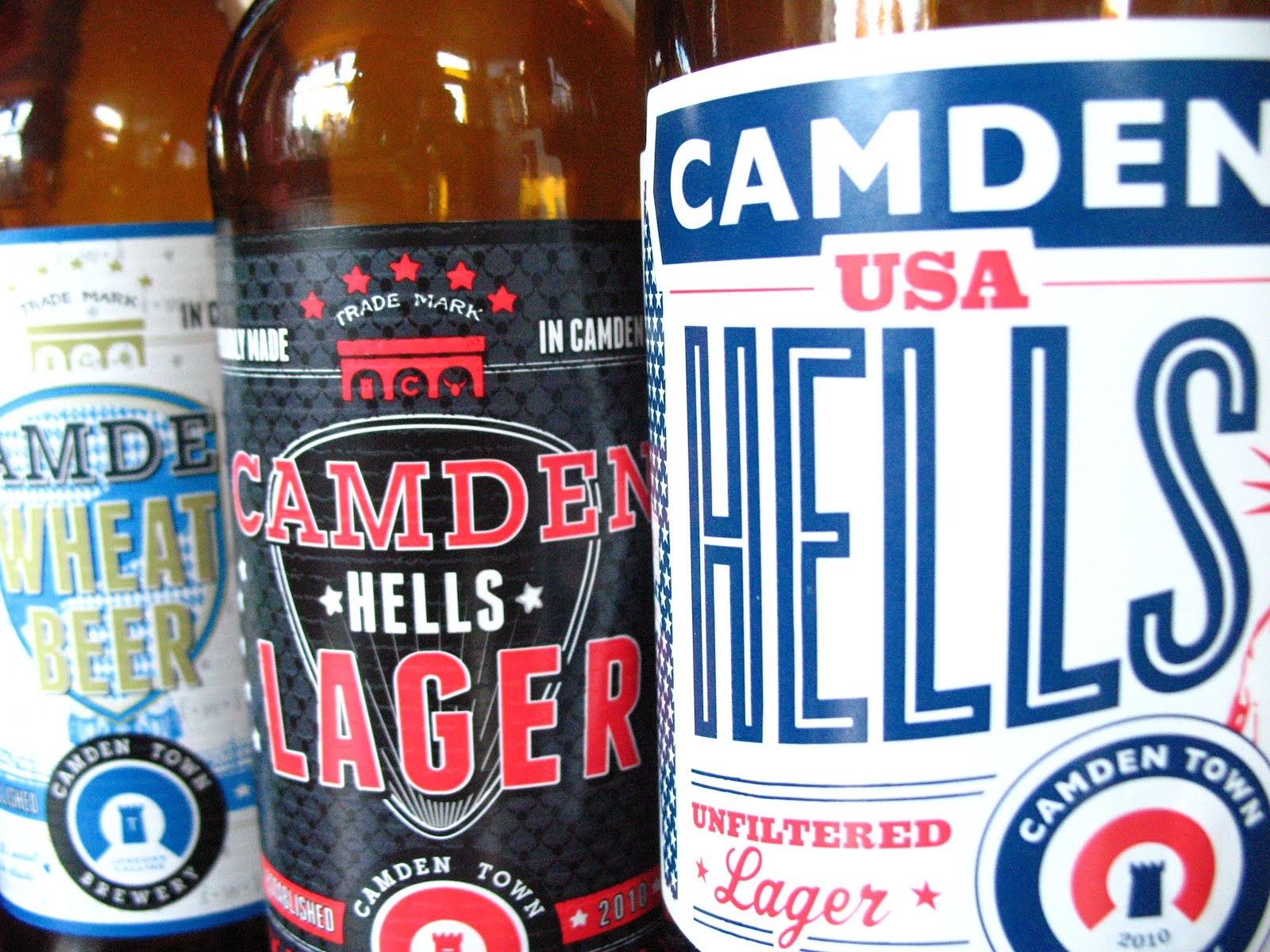 The weather turns warm and sunny. The sap rises. I want something different, something clean and fresh, something other than big chunky beers. Magically, a selection of beers from Camden Brewery, and a mini-cask of Sharp's Spring Cask Pilsner arrive at my desk, as though the beery gods have sensed a change in my mood, and can tell that I need placating a bit sharpish, matey.
The beers from Camden are good. The Hells Lager (apparently a stab at combining the helles and pils styles) works well, being a well-made lagery sort of a lager - clean, crisp and moreish. This is the beer you get if you go into a bar and ask for "a beer" - well-executed, transparently flawless, drinkable, bittersweet. The unfiltered version ups the ante a bit further, and the Unfiltered USA Hells slams down a hand of four aces and scoops the pot into its lap - zesty, slightly yeasty, but carrying that unmistakable hoppity-skippity of an unfiltered lager. It's just more alive, somehow.
Sharp's Spring Cask Pilsner is an essay in elegance. Brewers talk about having nowhere to hide when you brew a lager, but lagers such as Camden's have a distinct robustness when compared to this lager-ale hybrid. The Crafterati will hate it, even though it's a distant relative of Monsieur Rock. It's the opposite of an edgy, boundary-pushing beer, so ethereal as to be pummelled into submission by a full-bodied, unfiltered lager like Camden's. It's there, it's gone. Honey, herbs, lemons, fresh air and dewy grass. Can I have another please?
The Spring Cask Pilsner was such a gentle waft of spring breeze across the palate that that it got me thinking. Last night, I drank a Kernel Brewery Double Citra, so full of mangoes and passion fruit that its 9%+ abv slipped by unnoticed. It was the concentrated fruity essence of a hop that has been bred to be the concentrated fruity essence of hops. Have my doors of lupulin perception been pushed permanently ajar by the repeated ingestion of Double Citra, Double IPA, Imperial Black Ale? And more importantly, if they are, should I even care, or should I just yield to it and accept that the past is a different country, and things are going to be different from now on?
Friday, 30 July 2010
Now Drinking: Moylan's Hopsickle
.jpg) Look, I'll be totally honest here, the food in this video is what Alfred Hitchcock would have referred to as "the MacGuffin". I happened to be cooking the food that features in the video (yes, I know it seems like a eat merguez more often than is healthy, but I don't), and I happened to have a bottle of Hopsickle. And happily, they happened to be great partners (although the courgette fritters were a bit soggy - too much parmesan, I think).
Look, I'll be totally honest here, the food in this video is what Alfred Hitchcock would have referred to as "the MacGuffin". I happened to be cooking the food that features in the video (yes, I know it seems like a eat merguez more often than is healthy, but I don't), and I happened to have a bottle of Hopsickle. And happily, they happened to be great partners (although the courgette fritters were a bit soggy - too much parmesan, I think).I'm not really sure what to make of this beer. As you'll see in the video, the first sip goes down OK, and then about 5 seconds later, KABOOM!, a massive wave of bitterness comes out of nowhere and makes me go 'whoah!'. That's what this beer is like - it's one long 'whoah'. It's a 'w w w h h h o o o a a a h h h' of a beer. It's the antithesis of balance and elegance, it's a boot to the olfactory bulb and a punch to the fungiform papillae. In fact now I think about it, Hopsickle has all the grace of a couple of pool balls in a sock, as demonstrated by the young Ray Winstone in "Scum". You can see that scene here, but I warn you, there's an awful lot of violence and bad language in it.
I'm being a bit harsh there. Moylan's Hopsickle is a hell of a lot of fun to drink, but each mouthful stops just short of a physical assault. There is an initially sweet malty hit, then the chocolate/coffee notes hit from the malt (maybe crystal malt, but it tastes much darker). Then you get a burnt Seville orange character, then a wave of bitterness that is almost sensation rather than flavour. It's one of the hoppiest beers I've ever drunk - and that's not meant to sound like bragging, it's just a statement of fact. It's only just all in balance, but then I guess it only just needs to be.
Stand down Ray Winstone - Moylan's Hopsickle is the daddy now.
Sunday, 7 March 2010
Hop Back Summer Lightning: We've Come a Long Way, Baby
Last week, I visited my family in Salisbury. I was looking forward to it - of course, too see the family, and for our son to see his grandparents, but also because Salisbury is the home of the Wyndham Arms, the brewery tap for the Hop Back Brewery.
Last year, I wrote effusively (but briefly) about the Wyndham Arms (or "The Windy", as it's known locally) for an article in the Guardian about great Christmas pubs. My take on it is that the Windy is a great pub, and that it doesn't let anything get in the way of what a good pub should be. It's a classic pub in the truest sense - a public house, it feels like someone's living room (albeit with a bar and a shedload of awards on the walls).
Another reason I love the Windy is that the people who go there are the sort of people you want to find in a pub. They aren't there for drinks promotions, or karaoke, they are there for the no-nonsense pub, the beer, and the other pubgoers. But mostly the beer.
When Summer Lightning (5%abv) hit the scene in the late 1980s, it was a revelation - an unusually pale ale, stuffed full of dry citrus and spice flavour. It's still a bloody great beer, with a signature flourish of spice in the finish, and repeated samplings justify the scores of its awards that decorate the walls of the Windy. It's a benchmark beer, even after all this time.
But it is, to some degree, an old style of beer. These days. it's unusual for a pale golden beer to be so restrained. How hop character is expressed in beers, and pale beers in particular, has developed radically in the last ten years. Beers of this style are today as likely to taste of guava, passion fruit, grapefruit and lemon sherbet as they are to taste of pale malt and subtly spicy European hops.
This beer isn't a hop bomb, and it isn't absurdly strong, although it does have a bit of a kick to it. It's a beer that has incredible balance and poise, that is woven together from delicate flavours that don't rely on heavy hopping, or on a fancy malt bill. Like a good meal, it relies solely on the quality of the ingredients and the skill of the person who is putting it together. It's a beer that, to me, illustrates how the English brewing scene has changed over the last twenty years, and how drinkers' tastes have changed. Summer Lightning is a great beer, and although it is from a different age (I wonder how long a generation is in brewing terms?), it's still a classic.
Last year, I wrote effusively (but briefly) about the Wyndham Arms (or "The Windy", as it's known locally) for an article in the Guardian about great Christmas pubs. My take on it is that the Windy is a great pub, and that it doesn't let anything get in the way of what a good pub should be. It's a classic pub in the truest sense - a public house, it feels like someone's living room (albeit with a bar and a shedload of awards on the walls).
Another reason I love the Windy is that the people who go there are the sort of people you want to find in a pub. They aren't there for drinks promotions, or karaoke, they are there for the no-nonsense pub, the beer, and the other pubgoers. But mostly the beer.
When Summer Lightning (5%abv) hit the scene in the late 1980s, it was a revelation - an unusually pale ale, stuffed full of dry citrus and spice flavour. It's still a bloody great beer, with a signature flourish of spice in the finish, and repeated samplings justify the scores of its awards that decorate the walls of the Windy. It's a benchmark beer, even after all this time.
But it is, to some degree, an old style of beer. These days. it's unusual for a pale golden beer to be so restrained. How hop character is expressed in beers, and pale beers in particular, has developed radically in the last ten years. Beers of this style are today as likely to taste of guava, passion fruit, grapefruit and lemon sherbet as they are to taste of pale malt and subtly spicy European hops.
This beer isn't a hop bomb, and it isn't absurdly strong, although it does have a bit of a kick to it. It's a beer that has incredible balance and poise, that is woven together from delicate flavours that don't rely on heavy hopping, or on a fancy malt bill. Like a good meal, it relies solely on the quality of the ingredients and the skill of the person who is putting it together. It's a beer that, to me, illustrates how the English brewing scene has changed over the last twenty years, and how drinkers' tastes have changed. Summer Lightning is a great beer, and although it is from a different age (I wonder how long a generation is in brewing terms?), it's still a classic.
Subscribe to:
Posts (Atom)